

Blog
When Serialization Is Not Enough: The Difference Between Product Identification and Product Proof
Product serialization gives manufacturers something essential: the ability to distinguish one unit from another. A serial number can connect a physical product to a production record, shipment, transaction, or downstream event. But a unique identifier does not automatically prove that the object carrying it is genuine, correctly associated, or still in the state the record expects.
That distinction matters because modern production and supply-chain systems increasingly act on identifiers. A readable code can release a product, create a traceability event, trigger aggregation, support a warranty decision, or open a connected-packaging experience. If the relationship between the identifier and the physical unit is weak, every downstream system inherits that weakness.
Direct answer: Product serialization establishes unique identification at the unit level, but comprehensive product proof provides the broader evidence needed to build trust and ensure integrity by showing the identity was created under control, associated with the correct physical unit, verified during production, reconciled through exceptions, and connected to a defensible production record.
Product Serialization Solves a Necessary Identification Problem
GS1 describes serialization as identifying an individual instance with a serial number. A trade item can be uniquely identified by combining its GTIN and serial number, allowing events and traceability information to be associated with a specific unit rather than only a product class, lot, or batch.
That capability can support unit-level production records, aggregation, recall management, variable-data workflows, custody events, and downstream interactions.
The mistake is not using serialization. The mistake is asking serialization to answer a question it was not designed to answer on its own.
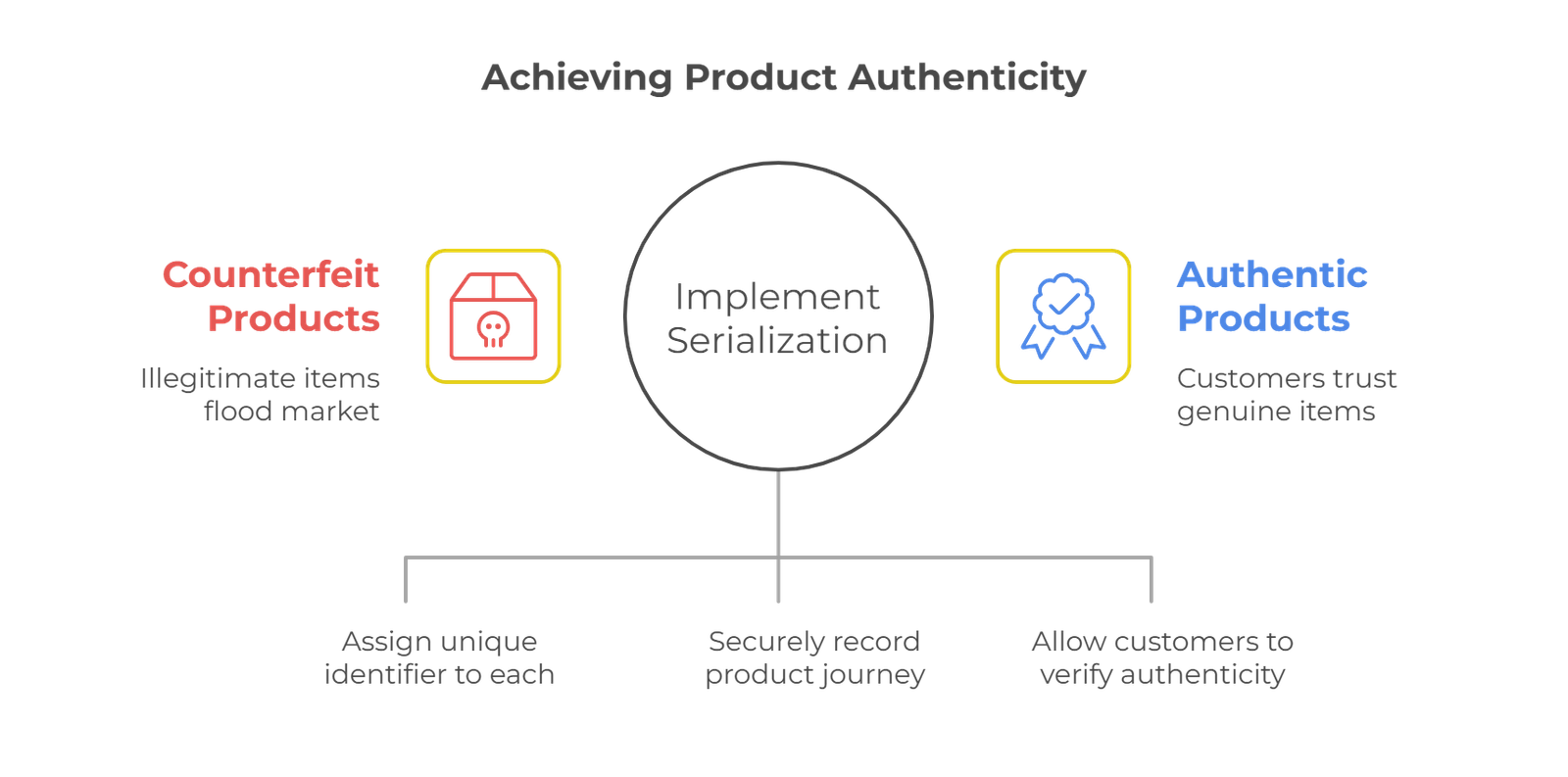
A serial number tells a system which unit an identifier claims to represent. It does not automatically establish that the identifier was applied to the intended unit, that a rejected identity was reconciled correctly, or that the object now presenting the identifier is still the legitimate physical unit associated with the original production record.
That is where identification and proof separate.
Identification and Product Proof Answer Different Questions
Identification asks: Which product, lot, asset, or unit does this identifier represent?
Product proof asks: What evidence supports the claim that this physical unit is legitimately associated with that identity?
Those questions are related, but they are not interchangeable.
The first article in this series, Tracking Is Not Identity: The Gap Intelligent Supply Chains Still Miss, established a similar distinction: tracking can reconstruct a journey without independently verifying the traveler. Serialization can uniquely name the traveler without, by itself, proving that the person presenting the name is the one to whom it was issued.
The stronger operating model combines identification with verification, fostering trust in the system’s reliability for industry professionals.
That means the question cannot stop at whether a serial number exists in a database. It must include how the identity was generated, where it was applied, what the line verified, how rejects and remakes were handled, and what evidence remains when a downstream system later evaluates the product, reinforcing accountability for supply chain managers.
What Can Major Technologies Actually Establish?
The answer is more nuanced than saying one technology “proves authenticity” and another does not.
Barcodes, QR Codes, RFID, NFC, machine vision, blockchain, digital signatures, and serialization can each contribute different forms of evidence, giving industry professionals confidence in layered security approaches.
Barcodes, QR Codes, and Serialized Identifiers
A barcode or QR code carries data. It can encode identifiers, serial numbers, URLs, batch information, or other structured data. Combined with serialization, it can make a physical unit uniquely addressable by downstream systems.
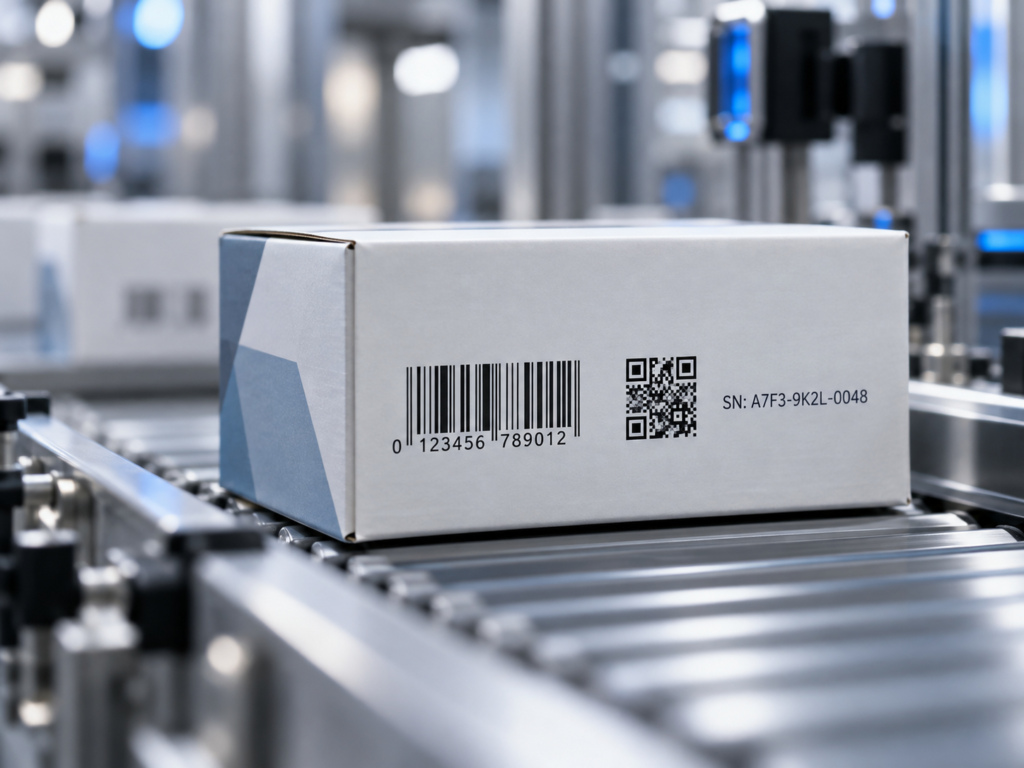
A conventional printed code can also be copied. That does not make QR or barcode technology inadequate. It means readability and uniqueness are different properties from authentication.s
Barcodes can also carry stronger forms of evidence. GS1’s Digital Signatures standard supports independent verification of the authenticity and integrity of digitally signed data, while ISO/IEC 20248 specifies methods for digitally signed data stored in barcodes or RFID tags.
The question is therefore not simply what carrier is used, but what is encoded, how it is protected, and how the carrier is associated with the physical item.
RFID and NFC
RFID expands identification and data capture by allowing electronic reading of tagged objects. GS1’s Electronic Product Code, for example, is an identification scheme for serialized physical objects that can be carried through RFID.
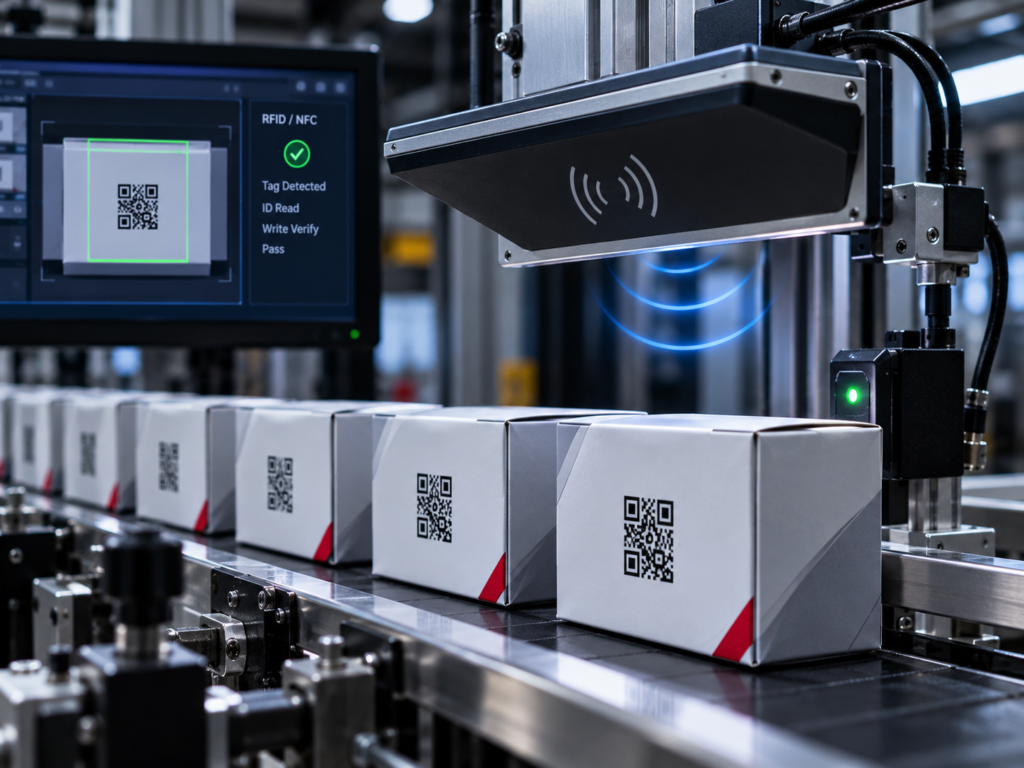
NFC adds short-range interaction and can support product information, access control, customer engagement, and authentication use cases.
It would be incorrect to say RFID or NFC cannot support authentication. Secure NFC implementations can use cryptographic mechanisms, secure elements, digital signatures, and authentication protocols. The NFC Forum maintains an authentication protocol for secure data transfer.
The practical question is: What security properties do the specific tag, chip, protocol, key-management model, and verification workflow provide, and how is that tag associated with the intended product during production?
Machine Vision
Machine vision provides another form of evidence.
A configured vision system can verify observable attributes such as code presence, readability, print content, orientation, position, dimensions, assembly state, or surface condition. The Association for Advancing Automation identifies assembly verification, presence-or-absence checks, defect detection, product identification, and differentiation as common inspection tasks.
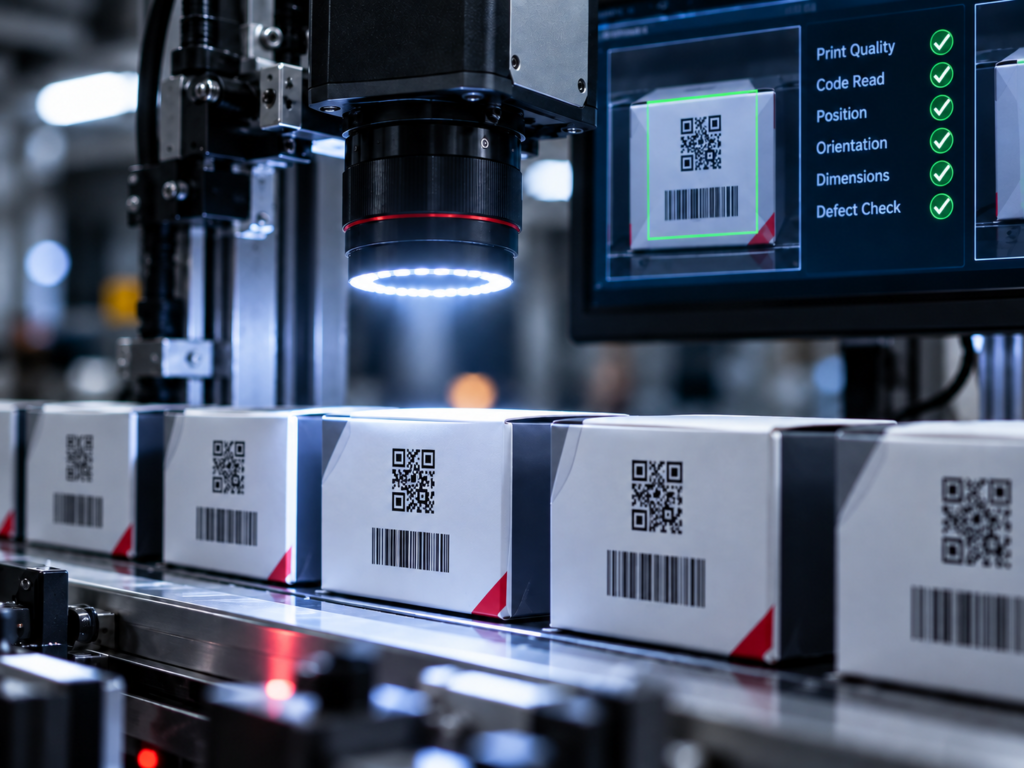
This makes vision particularly valuable where digital identity meets physical production. The line can inspect whether the expected identifier is present, compare printed information with job data, confirm defined package attributes, and trigger reject logic when configured requirements are not met.
But machine vision is not a universal authenticity engine. It verifies the attributes it can observe and the rules it has been configured to evaluate. Authentication technology likewise does not replace vision when the requirement is print quality, placement, presence, assembly, or defect containment. The two become more valuable when the inspection result is connected to the serialized production record.
Blockchain and Distributed Ledgers
Blockchain can strengthen the integrity of shared records. NIST describes blockchain as a distributed ledger designed to be tamper-evident and tamper-resistant.
But ledger integrity and physical-product identity are different control questions.
A blockchain can preserve the fact that an event was recorded. It does not independently determine whether the physical object involved in that event was genuine or correctly associated with the identifier presented at the time.
This does not diminish blockchain. It defines its role more accurately.
A trusted event ledger is more valuable when the event entering it is grounded in controlled production evidence.
The Missing Layer Is Not Another Identifier
When product proof is weak, the natural response is often another code, tag, database, scan, or security feature. That may help, but it can leave the underlying operating model unchanged.
The more useful question is whether production controls the full identity lifecycle.
Five Control Points Behind Product Proof
1. Identity creation
The system needs to know which identities are valid for the job, product, site, line, and production context. Access, allocation, duplication rules, and unused identities all matter.
2. Physical association
The correct identity must be applied, printed, encoded, or otherwise associated with the correct physical unit. A valid serial number on the wrong unit is still a control failure.
3. In-line verification
The line should verify the attributes required by the application while the unit remains inside the controlled workflow. That may include code content, readability, data match, chip response, tag data, print, package condition, or other configured criteria.
4. Exception handling and reconciliation
Rejected, reworked, remade, duplicated, unused, or uncertain identities need a governed disposition. Otherwise, the database and physical output can diverge.
5. Production record
The final record should preserve enough evidence to explain what was created, applied, verified, rejected, reconciled, and released. This is the difference between a collection of technologies and a trust architecture.
It also reflects Pack-Smart’s messaging standard: inspection, serialization, reject handling, reconciliation, and production records create value when they operate as connected production logic, not isolated functions.
Production Is Where Product Proof Is Won or Lost
Many identity failures begin before the product enters the supply chain.
A code can be generated correctly and applied to the wrong unit. A serialized label can be reprinted after the original unit was rejected. A tag can be encoded but associated with the wrong product. A vision system can identify a mismatch, but the reject may fail to remove the unit. A line restart can create uncertainty around which serials were consumed. A remake can create two physical units competing for one digital identity if reconciliation is weak – these are production-control problems.
A distributor, retailer, regulator, brand owner, or customer may later scan the product, but the reliability of that check depends on what production preserved. If the line did not maintain the relationship between the physical unit, its identifier, verification result, exception history, and release status, downstream systems have less evidence to evaluate.
Trust is built before the scan because production creates the facts that the scan later interrogates.
That aligns with Pack-Smart’s line-level proof principle: product integrity must be established while the product remains inside the controlled workflow, not reconstructed after production from incomplete records.
Product Proof Is Cumulative Evidence, Not a Single Feature
“Product proof” should not imply a single technology that makes every authenticity decision absolute.
A more useful definition is cumulative.
Product proof is the evidence created when a product’s identity is issued under control, physically associated with the intended unit, verified against defined rules, reconciled through exceptions, and preserved in a governed production record that can support later decisions.
Different technologies contribute different evidence to that chain.
Serialization establishes uniqueness. QR and barcodes carry data. RFID and NFC enable electronic identification and, in secure implementations, can support stronger authentication. Machine vision verifies observable product and print attributes. Digital signatures can authenticate data and detect tampering. Ledgers can preserve shared event history. Software governs records, state, and business rules.
The system-level question is how those components work together.
That is the most useful evaluation standard for converters, brands, manufacturers, quality teams, and technical evaluators because it replaces feature comparison with control logic.
Five Questions Buyers Should Ask
When evaluating serialization and traceability, anti-counterfeiting technology, or product authentication technology, buyers should ask:
- What exactly is being proven? Readability, uniqueness, data integrity, source authenticity, physical-product association, or some combination?
- Where is identity created and governed? Who can issue, allocate, reuse, cancel, or rework an identity?
- How is the identity associated with the physical unit? What prevents a valid identity from being applied to the wrong product?
- What happens when verification fails? Is the unit contained, rejected, reconciled, and reflected correctly in the production record?
- What evidence survives downstream? Can later systems distinguish a valid identifier from a verified production outcome?
Those questions move the conversation from technology selection to control design.
The Decision Is Not Serialization or Authentication
Product serialization remains a foundation for unit-level traceability. The next step is not to replace it with another technology. It is to decide what the serialized identity must support.
For some applications, identification and traceability are sufficient. For others, the product must also support authentication, secure data exchange, physical-feature verification, or downstream proof tied to the production record.
Pack-Smart Inc. approaches the problem as connected production logic rather than standalone code or a reader. Serialization, variable-data printing, data reading, machine vision, reject handling, reconciliation, and production reporting can be coordinated so the physical product and its digital identity remain aligned through the line. This is consistent with Pack-Smart’s current serialization, data read/write, and anti-counterfeiting application architecture.
Delta-X Trust extends that control into the governed data environment by connecting product identity, production events, verification outcomes, exception history, and downstream checks. That positioning aligns with the approved Delta-X Trust messaging framework rather than treating authentication as a code or isolated software feature.
The distinction is simple: Identification tells a system what the product claims to be. Product proof is the evidence that allows the system to decide how much trust that claim deserves.
As more production and supply-chain decisions become automated, the objective is not to choose one technology that “proves” the product. It is to design a system in which the identity, physical unit, verification logic, and production record remain connected from creation through release.