

Blog
Post-Purchase Engagement: Why Packaging Is the Next Customer Channel
Post-purchase engagement is often treated as an email, delivery, customer service, or loyalty workflow. Those channels matter, but they share one weakness: they sit outside the physical product the customer has already chosen.
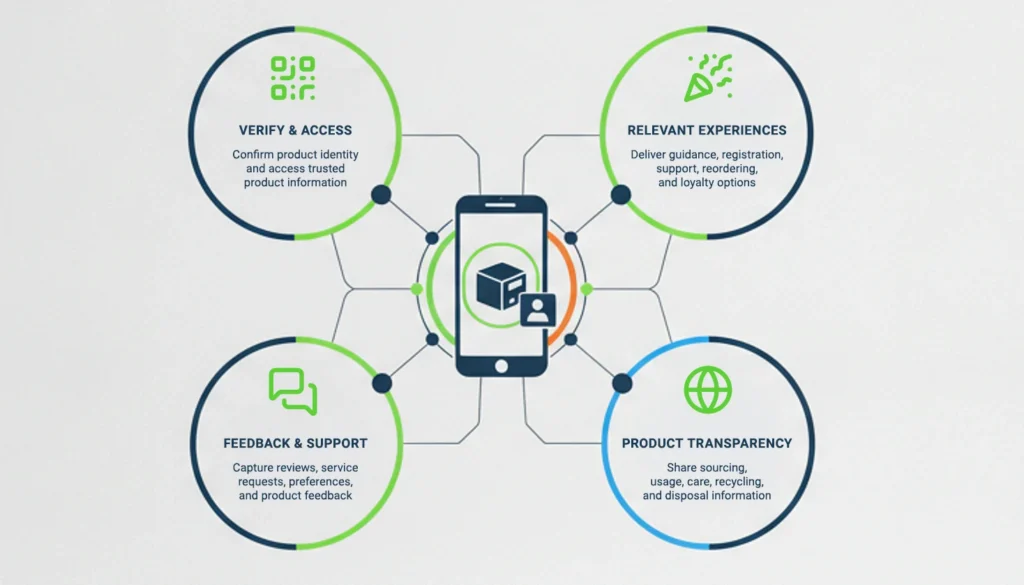
Packaging changes that equation. It reaches the customer with the product, carries the brand into the moment of use, and remains available after the transaction is complete. When the package is connected to a governed digital experience, it can support instructions, registration, authentication, reordering, loyalty, support, feedback, and other services that are relevant to that specific product.
The opportunity is not to place another QR code on a carton. It is to make packaging part of a controlled post-purchase customer strategy. That requires a clear customer purpose, a trustworthy product identity, verified production output, disciplined data use, and an operating model that connects marketing, operations, quality, IT, legal, and customer service.
What Is Post-Purchase Engagement?
Post-purchase engagement encompasses interactions that happen after a transaction, emphasizing its strategic value to support customer loyalty and trust.
Many post-purchase marketing programs concentrate on delivery updates, follow-up emails, surveys, and promotional offers. These activities can support customer retention and brand loyalty, but they do not always reach the customer at the moment a product question or need appears. Packaging does. A scan, tap, or product-specific link can connect the customer to information and services while the product is physically in front of them.
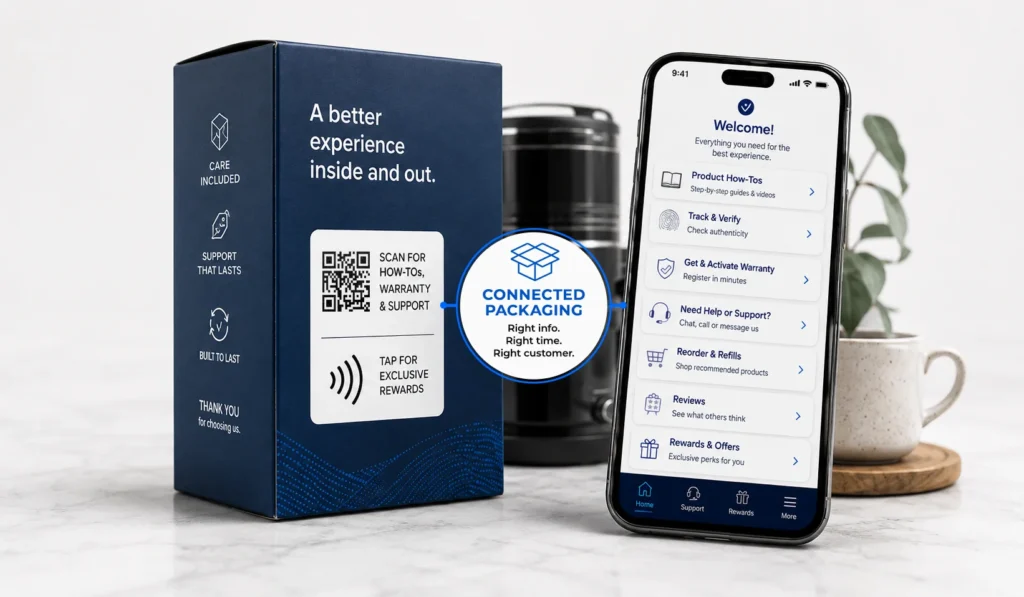
That makes packaging a customer channel, not just a promotional surface, encouraging the audience to see practical ways to enhance customer experience with less friction.
From Industrial Scale to Customer Relevance
Industrial progress has repeatedly changed what manufacturers can control. Mechanization created power. Mass production created repeatable scale. Automation improved speed and consistency. Connected production made it possible for machines, software, products, and production data to operate as parts of one system.
The ability to introduce controlled variation and support ongoing experiences shows how connected production can make brands more relevant and trustworthy to customers.
This is where mass personalization and post-purchase engagement meet. Variable-data printing, digital finishing, automation, machine vision, and connected production software can introduce controlled differences in names, languages, imagery, regional content, product information, and digital destinations. The purpose is not variation for its own sake. It is to create a more relevant product or experience without losing control of what was produced, for whom, and under which job conditions.
Why Packaging Is an Underused Post-Purchase Channel
Packaging has traditionally been optimized for protection, transport, regulatory information, shelf recognition, and conversion. Those roles remain essential. What changes after purchase is the context.
The package is now in the customer’s hands, home, workplace, clinic, or business. It can answer a different set of questions:
- Is this the right product and can its identity be verified?
- How should it be installed, used, stored, maintained, or disposed of?
- Where can the customer find product-specific support?
- Can the product be registered or a warranty be activated?
- Is replenishment, reordering, or a compatible product available?
- Can the customer provide feedback or join a loyalty experience?
- Does information need to change by language, region, batch, product status, or lifecycle stage?
These are not all marketing questions. They involve service, quality, product management, compliance, commerce, and customer trust. Packaging for consumer engagement creates value when it gives the customer a useful next action and gives the business a governed way to support that action. Treating packaging as a customer channel also clarifies which teams must support the experience after launch.
How Connected Packaging Supports Post-Purchase Engagement
Connected packaging can link a physical product to digital information or services through QR codes, GS1 Digital Link-enabled 2D barcodes, NFC, RFID, digital watermarks, serialized marks, or other data carriers. GS1 describes QR codes using GS1 Digital Link syntax as a way to connect consumers with online product information. The carrier creates access, but the experience’s accuracy, relevance, and trustworthiness depend on the underlying identity and production system behind it.
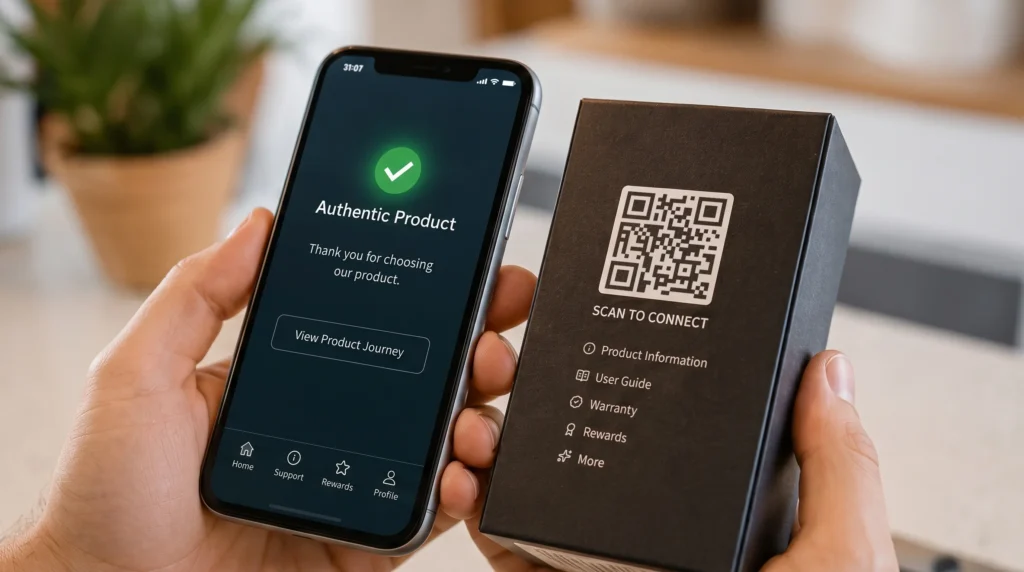
A useful post-purchase experience aligns four elements:
- Customer purpose: the action or information that creates value after purchase.
- Product identity: the product, batch, unit, package, region, or campaign the interaction represents.
- Digital destination: the content, service, authentication logic, registration flow, or offer the customer reaches.
- Production proof: the record showing that the correct identity and connected element were applied to the correct package and released as valid output.
Pack-Smart’s existing article on connected packaging solutions explains this technical foundation in detail. The strategic distinction here is what the architecture is for: extending a relevant, measurable, and governed customer relationship beyond the initial transaction.
What Should the Customer Get After the Scan or Tap?
The visible interaction should solve a problem, reduce uncertainty, or make the product more useful. A scan that opens a generic homepage adds another step without adding much value. A product-aware experience can do more.
Depending on the application, customer engagement through packaging may support:
- Product-specific instructions, setup, dosage guidance, or training
- Authentication or a product-status check against an authoritative record
- Warranty activation, product registration, or ownership transfer
- Reordering, replenishment, compatible products, or service parts
- Loyalty participation, rewards, offers, or personalized content
- Support, troubleshooting, maintenance, or service requests
- Provenance, ingredients, allergens, recycling guidance, or product updates
- Feedback connected to a product type, batch, region, or point in the lifecycle
The choice should follow the product and the customer’s context. A premium cosmetic, medical device, food product, secure credential, replacement component, and folding carton do not need the same post-purchase journey. Relevance comes from deciding which interaction improves the product experience, not from maximizing the number of available features.
From Personalization to Participation
Personalization demonstrates how physical products can invite customers into the brand experience. Nike By You allows customers to choose design elements and add a personal identifier to selected footwear. Coca-Cola’s Share a Coke campaign turned packaging into a social object, and its 2025 return used on-pack QR codes to connect personalized packages to a digital hub and shareable experiences.
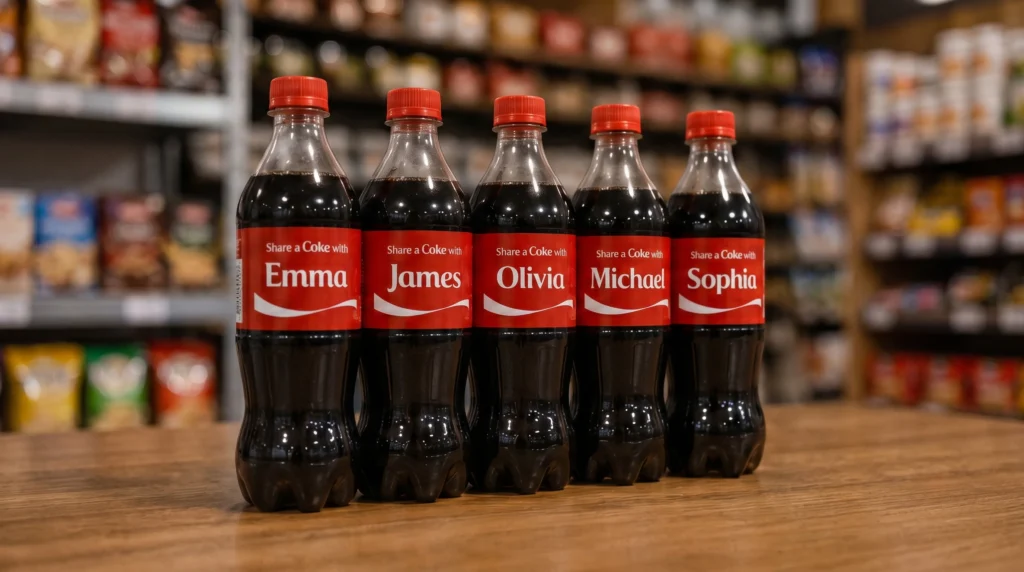
These examples are not identical to post-purchase engagement, but they expose an important progression. Personalization makes the product feel more relevant before or at purchase. A connected product experience can continue that relevance through use, support, community, replenishment, and repurchase.
The deeper opportunity is participation. The customer is not asked merely to notice a customized design. They are given a reason to act, learn, verify, register, share, respond, or return. The package becomes useful when it helps the customer accomplish something they care about.
Research should not be treated as proof that every product requires personalization. It does show that relevant experiences can influence preference and spending. A 2024 Deloitte study reported that 80% of surveyed consumers preferred brands offering personalized experiences, while those consumers reported spending 50% more with those brands. The operating decision remains category-specific: where does relevance create enough customer and commercial value to justify the production, data, and governance required?
A Code Is Not a Customer Engagement System
Many programs begin with the visible technology. The team selects a QR code, NFC tag, serialized label, or digital destination and assumes the connected experience has been designed. That is the easiest part to demonstrate and the easiest part to overvalue.
A code can open a page. It cannot define the customer purpose, confirm that it was applied to the right product, govern permissions, reconcile rejected output, or determine how the business will act on the resulting data. Those responsibilities belong to the system around the code.
A credible post-purchase engagement program must connect customer strategy to production reality. The identity model, data carrier, artwork, print or encoding process, inspection logic, exception handling, digital destination, consent model, measurement plan, and ownership structure must agree. If any of these elements is disconnected, the package may appear interactive while the operating model remains fragmented.
This is why connected packaging should not be evaluated only through scan rates or creative execution. The real standard is whether the physical package, digital identity, customer experience, and production record stay aligned.
Trust Is Built Before the Customer Interaction
The customer sees the scan or tap. They do not see the production controls that make the result dependable.
Before a connected package reaches the market, the production environment may need to create or receive the correct identity, print or encode the data carrier, inspect presence and readability, verify placement, confirm the product-to-identity relationship, remove non-conforming output, and reconcile accepted, rejected, and reworked units against the job record. Only validated output should proceed to pack-out and distribution.
The required controls depend on the application. A campaign-level code and a serialized authentication identity do not carry the same risk or data requirements. In higher-consequence environments, weak identity governance can create incorrect product information, false verification results, traceability gaps, or records that cannot support an investigation.
Pack-Smart’s articles on counterfeit pharmaceuticals and pharmaceutical serialization architecture examine production and identity problems in regulated applications. The broader principle also matters in customer engagement through packaging: downstream trust inherits the quality of upstream execution.
What the Data Is For
Every scan, registration, support request, authentication check, reorder, or feedback event can create data. Volume is not the objective. Better decisions are.
Before collection begins, the business should define:
- What information is necessary for the use case
- What value the customer receives in exchange
- Whether consent is required and how it will be recorded
- Which systems will store, process, or share the information
- Who can access it and for what purpose
- How long it will be retained
- How customers can exercise applicable privacy rights
- Which decisions or workflows the data is expected to improve
Useful signals might help a team understand registration, repeat purchase, product education, regional demand, authentication activity, support needs, product performance, or campaign response. Data without a defined decision becomes cost. Data without governance becomes exposure. Data without action becomes noise.
The objective is not to collect everything a connected package could reveal. It is to build a governed data environment that supports the promised customer experience and the business outcome behind it.
Who Owns the Post-Purchase Customer Experience?
The customer experiences one brand, even when the business is organized into separate functions. Marketing may own the campaign. Operations own production. Engineering owns equipment. IT has integrations. Quality owns acceptance logic. Legal and privacy teams govern data use. Customer service owns the request that arrives after the scan.
Suppose each team optimizes only its own component, the post-purchase experience fragments. A technically successful code may direct the customer to outdated content. A useful digital destination may be disconnected from product status. A campaign may collect data the service team cannot use. A production system may create reliable identities without a clear customer purpose.
The operating model needs one defined outcome, named ownership, shared acceptance criteria, and clear escalation paths. Technology can connect the workflow, but accountability determines whether the experience remains coherent.
How to Measure Post-Purchase Engagement Through Packaging
Measurement should reflect the customer action and business case, not the novelty of technology. Scan volume can be useful, but it rarely explains value on its own.
A measurement framework may include:
- Reach: eligible packages produced, distributed, and available for interaction.
- Activation: scans, taps, registrations, or verified first interactions.
- Completion: instructions viewed, registrations completed, products authenticated, support issues resolved, or reorders completed.
- Customer value: reduced effort, faster access to information, greater confidence, or improved product use.
- Commercial value: repeat purchase, retention, revenue per customer, loyalty participation, or service conversion.
- Operational quality: identity accuracy, code readability, reject containment, reconciliation status, and validated release.
- Risk and governance: consent quality, access control, data retention, unresolved exceptions, and abnormal authentication activity.
The correct metrics vary by use case. A warranty program should not be judged as a loyalty campaign. An authentication experience should not be judged like a reorder flow. The metric should prove whether the package helped the customer complete the intended action and whether the business can support that action reliably at scale.
How to Pilot and Scale the Model
A pilot is useful when it tests the operating model, not simply whether a phone can scan a code.
Start with one customer problem and one measurable hypothesis. Define the product scope, identity level, data carrier, destination, production controls, privacy requirements, support workflow, and acceptance criteria before the run begins. Establish what constitutes accepted, rejected, reworked, and unresolved output. Decide which metrics will determine whether the program should stop, change, or scale.
Then test under real production and customer conditions. Substrate variation, coatings, folds, line speed, camera geometry, lighting, network behavior, mobile devices, language, regional rules, and customer context can all affect performance. A successful demonstration is not the same as stable production.
Scale only after both sides of the model hold. The customer must use and value the experience, and the production and data architecture must support it without creating uncontrolled exceptions or operational drag. Speed matters when verification, governance, and customer relevance keep pace.
Connected Customer Packaging: A Pack-Smart Inc. Model
Connected Customer Packaging is a useful way to describe the operating model: packaging that combines controlled product identity, digital interaction, production data, and customer engagement to support a continuous relationship between a brand and the customer.
It is not presented as a replacement for established connected-packaging terminology. It names the strategic outcome that established technologies can support.
The model rests on four coordinated responsibilities:
- Create customer value. Define the post-purchase need and the action the package should enable.
- Control product identity. Determine what the connected element represents and how it remains associated with the correct physical output.
- Prove production. Apply, inspect, verify, contain exceptions, reconcile data, and release validated output.
- Govern the relationship. Manage destinations, permissions, measurement, service, content, and lifecycle decisions across functions.
This framing keeps the business outcome in view. The code is a carrier. The digital destination is an interface. The production record is the proof. The relationship is the value the system is designed to support.
Pack-Smart Inc. operates where those responsibilities meet the line. That includes material handling, variable-data printing, labeling, serialization, RFID and NFC integration, machine vision, inspection, reject handling, data reconciliation, and the governed production logic required to connect physical output with downstream experience. The purpose is not to add technology to a package. It is to engineer a controlled path from production identity to customer interaction.
The Beginning of the Next Interaction
Post-purchase engagement should not be an automated follow-up attached to the end of a transaction. For the right products and use cases, it can be designed into the product experience itself.
Packaging is well placed to support that shift because it already reaches the customer, carries the product identity, and remains present at the moment of use. Digitization adds the ability to connect, verify, guide, learn, and respond. Production control determines whether that connection can be trusted.
The strategic decision is not whether every package should become interactive. It is where packaging can remove customer friction, support product integrity, create a useful data event, or strengthen the next commercial interaction. When that purpose is clear, and the operating model is controlled, the package no longer marks only the end of production. It becomes the beginning of the next customer relationship.