

Blog
Tracking Is Not Identity: The Gap Intelligent Supply Chains Still Miss
Supply chains are becoming better at recording movement, condition, and custody. Yet those records can still describe the wrong physical unit. The identity gap arises when a system trusts a product’s digital history without independently verifying the object that carries the identifier.
A modern supply chain can record when a unit was produced, its lot, its movements, its receiver, and whether its temperature remained within a defined range. These records support inventory control, recall readiness, regulated reporting, and faster operational decisions.
A system may reconstruct a product’s journey without physically verifying the unit, undermining supply chain managers’ confidence in authenticity. This is the identity gap.
Product authentication asks a different question from a movement record. It asks not only, “Where has this item been?” but, “What evidence shows that this physical unit is legitimately bound to this identity and production record?” For increasingly automated supply chains, the difference is becoming a control requirement rather than a semantic distinction
DIRECT ANSWER
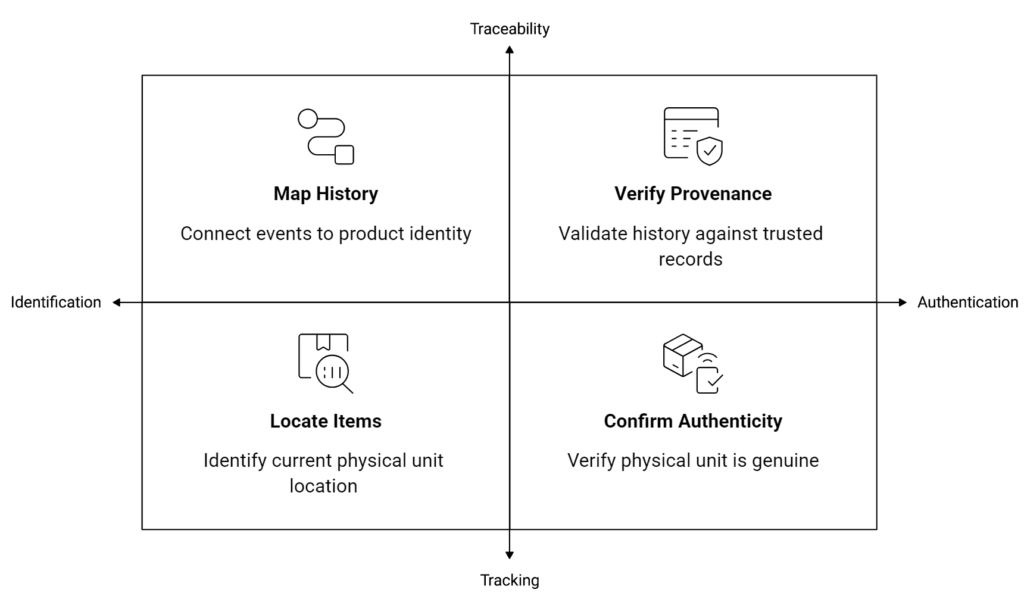
Product tracking shows where an item is or has been. Product traceability connects the events that form its history. Product identification tells a system which product, lot, or serialized unit an identifier claims to represent. Product authentication asks the harder question: can the physical unit in front of the reader be verified against a trusted identity and production record?
Supply Chains Can Track the Journey and Still Miss the Product
The GS1 Global Traceability Standard describes traceability as the ability to trace the history, application, or location of an object. GS1’s broader standards model organizes supply chain information around the identification, capture, and sharing of data. That structure is fundamental to modern commerce because events cannot be connected if the parties, locations, and products involved cannot be referenced consistently.
The control issue appears at the physical handoff. A reader captures an identifier, but without physical verification, quality assurance teams may remain uncertain if the object is the same as the record describes.
If an identifier has been copied, applied to the wrong product, or left active after a rejected unit was not reconciled correctly, the underlying record can still appear legitimate. The system may be reading valid data from the wrong object. The identity gap is therefore not a failure of tracking or traceability. It is a missing control layer between the physical unit and the digital record.
Tracking, Traceability, Identification, and Authentication Are Different Control Layers.
Terminology varies across industries and technology providers. For this article, product identity means the governed, unit-level association between a physical product and its digital production record. It does not mean that every printed identifier is automatically proof of authenticity.
| Layer | Primary question | What it establishes | What remains unresolved when used alone |
| Product tracking | Where is the item, or where has it been? | Location, status, and movement events. | Whether the physical object is legitimately tied to the identifier being tracked. |
| Product traceability | What happened across the product’s history? | Event sequence, lineage, custody, transformations, and relationships. | Whether the object now presented is the intended unit rather than another object carrying its data. |
| Product identification | Which product, lot, asset, or unit does the identifier claim to represent? | A consistent key used to capture and retrieve information. | Whether the identifier and its physical carrier should be trusted in the current context. |
| Product identity | Which governed record belongs to this specific physical unit? | The expected association between the unit, its attributes, and its production record. | Whether that association can be verified at the decision point. |
| Product authentication | Does the evidence support the unit’s claimed identity? | An authentication result based on the system’s defined evidence and rules. | Its reliability depends on controlled issuance, association, exception handling, and governance, which helps logistics professionals trust the system’s integrity. |
These layers are complementary. Product authentication does not replace supply chain traceability, and traceability does not become less valuable because authentication is required. The stronger operating model connects them so the event history belongs to a unit whose identity can be evaluated when a decision depends on it.
The Passport-Control Test
An airport offers a useful analogy. A boarding pass describes the journey. A passport carries identity information. Border control does not treat the itinerary as proof of who is presenting it. The travel record and the identity check serve different purposes.
The International Civil Aviation Organization describes ePassport validation as checking the chip’s digital signature to confirm that a bona fide authority issued the document and that its information has not been altered. Where supported, additional mechanisms can help detect a copied chip. The document data and image are then compared with the physical passport and the person presenting it.

The useful lesson is not that every product needs a passport chip. It is that route evidence and identity evidence answer different questions. Many supply chains have a detailed itinerary and a unit-level identifier. The identity gap persists when the handoff lacks a reliable way to verify that the physical unit, the identifier, and the trusted record still belong together.
Automation Makes Missing Identity Evidence More Consequential
Human-led handoffs can create an informal challenge point. An experienced receiving clerk could notice that a label looked wrong, that a package felt inconsistent, or that the product did not match the record. Human judgment is never complete or scalable, but it gave suspicion somewhere to surface.
Many automated workflows are designed to remove that pause. They act on defined inputs, records, tolerances, and business rules. If identity evidence is not among those inputs, the workflow can validate the shipment and release the product without ever testing the physical claim underlying the data.
A Matching Record Is Not the Same as a Verified Unit
Consider an automated receiving decision. The identifier is readable. The serial record exists. The item appears on the advance shipping notice. The location and time are expected. Every data relationship can match while the physical unit remains unverified. The system has shown that the claim is plausible, not that the object is authentic.
Automated Systems Cannot Infer Evidence They Were Never Given
Artificial intelligence can detect anomalies, compare patterns, and improve decision speed. It cannot recover a missing association between a physical product and its origin record unless the architecture captures evidence of that association. This is not primarily an algorithm problem. It is a control design problem.
A Weak Identity Signal Can Become a Trusted Event
Once an unverified unit is accepted, the scan becomes part of the product history. Inventory, analytics, quality investigations, warranty processes, and downstream automation may treat that event as fact. More automation does not create the identity gap, but it can carry the consequence of a weak handoff farther and faster.
Where the Identity Gap Begins
The gap often begins before distribution, at the point where product identity first meets physical production. This is why product trust starts on the production line. Common failure modes include:
- Identity data is generated or allocated without sufficiently governed job, site, line, or access controls.
- An otherwise valid identifier is printed, encoded, or applied, but it is associated with the wrong unit, lot, package, or production record.
- The carrier is readable, but the line does not verify the required content, placement, encoding result, or product match before release.
- A rejected, remade, or reworked unit is not contained and reconciled against the identity record.
- A downstream verification check queries a record that does not reflect what happened during production or exception handling.

Each failure weakens the association between the digital record and the physical unit. A downstream dashboard can accurately report the available data yet still lack the evidence needed to reconstruct that association after the product leaves the controlled workflow.
What a Product Authentication Architecture Must Add to Traceability
A stronger product authentication architecture complements product traceability with five connected controls:
- Govern identity issuance. Create and allocate identity data under controlled roles, job logic, and production conditions.
- Verify physical association. Confirm that the right identity is applied to the right product, package, or hierarchy level before release.
- Contain exceptions. Prevent rejected or remade units, duplicated identifiers, and unresolved identity records from re-entering the workflow without a governed disposition.
- Ground downstream checks in production truth. Resolve later scans against a record that includes verification results and exception history, not only identifier existence.
- Preserve an auditable evidence chain. Record who or what created, applied, verified, rejected, reconciled, and released each unit, including any change to its associated identity state.
The technology mix will vary by application. Serialized codes, RFID, NFC, physical security features, machine vision, digital credentials, databases, and analytics can all play a role. No individual component should be treated as the complete trust architecture simply because it stores an identifier or records a journey. The control test is whether the system can produce a defensible result about the physical unit and manage the exception when that result fails.
The Executive Question Is Not ‘Can We Track It?’
Supply chain, operations, quality, and digital transformation leaders should examine every handoff where a scan causes a system to receive, route, release, activate, pay, or replenish. At each point, ask:
- What is actually being checked: readability, record existence, expected location, product match, or authenticity?
- How was the identity created, assigned, and associated with the physical unit?
- What evidence survives rejection, rework, aggregation, repacking, or another exception?
- What decision follows the verification result, and how is a failed or uncertain result contained?
- Which downstream systems will treat the result as trusted input?
If the answer stops at “the record exists,” the identity gap remains. The system knows that the claim is recognized. It does not yet know whether the physical object deserves the trust attached to that claim.
Pack-Smart Inc. and Delta-X Trust address the point at which digital identity becomes a physical product. Pack-Smart coordinates the production mechanisms that apply, read, inspect, reject, and reconcile identity-bearing output. Delta-X Trust governs identity data, production events, verification outcomes, exception history, and downstream checks. The architecture depends on the application, but the principle is consistent: downstream trust should begin with a controlled association on the line.
Tracking records movement. Traceability connects the events. Identification provides the key used to retrieve the record. Product identity establishes the governed association between that record and a specific physical unit. Product authentication tests whether the evidence supports that claim. An intelligent supply chain needs all five.
Before the next automated handoff, the practical question is simple: does the system know only where the product has been, or can it verify that the physical unit is legitimately tied to the identity it claims to have?
Related reading: Connected Packaging Solutions