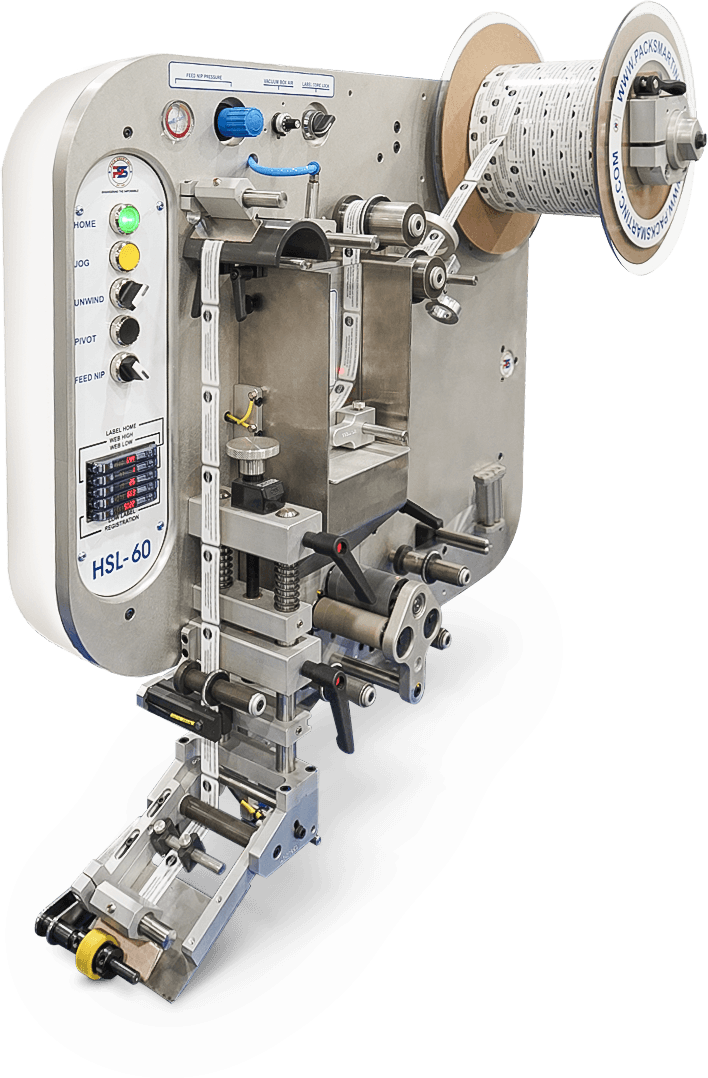
HSL-60
High-Speed Label Applicator
The HSL-60 is a highly versatile module that applies pressure sensitive labels at high speeds and accuracy for the most demanding precision-critical applications.
Technology Category
High-speed labelling technologies coordinate label supply, product registration, application timing, identity, and verification as production speed increases. Pack-Smart Inc. supports pressure-sensitive, print-and-apply, tape, closure, and other label-driven production requirements.
High-Speed Labelling Technologies
A label has to arrive at the application point in the correct state, meet a controlled product position, and remain associated with the right product as line speed increases.
Pack-Smart integrates pressure-sensitive label application into packaging, card, carton, specialty print, personalization, and pack-out systems. Labelling can be coordinated with product feeding, registration, variable printing, barcode or data reading, inspection, reject handling, and production tracking.
The required application method depends on label construction, liner, adhesive, roll condition, product geometry, surface, placement tolerance, line speed, dispense direction, and downstream handling. High-speed performance depends on synchronization between label dispense and the actual product position, not simply on the rated speed of the applicator.
Technology Category
Explore the Pack-Smart technologies assigned to this category. A category can include multiple technologies with different functions, configurations, and application requirements.
The HSL-60 is a highly versatile module that applies pressure sensitive labels at high speeds and accuracy for the most demanding precision-critical applications.
Relevant Systems
The technologies in this category are used in the following Pack-Smart automated systems.
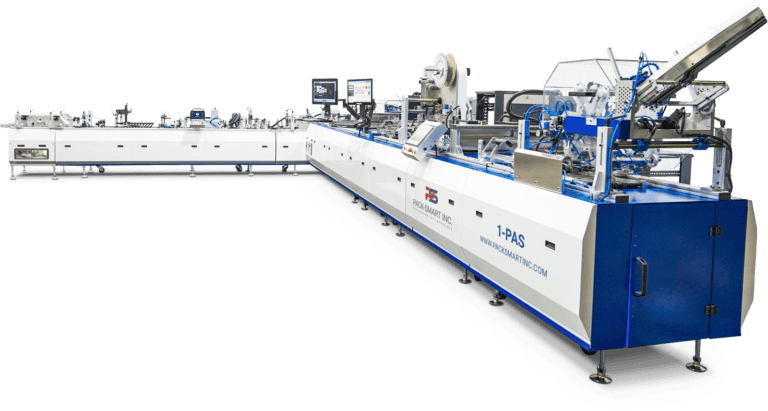
The 1-PAS Inline Secure Card Packaging System personalizes, affixes, seals, batches, bundles, and packs out secure open and closed loop cards in one workflow. It supports 20,000 PPH, duplex personalization, 600 DPI UV DOD printing, ±0.5 mm affixing accuracy, and Delta-X reporting.
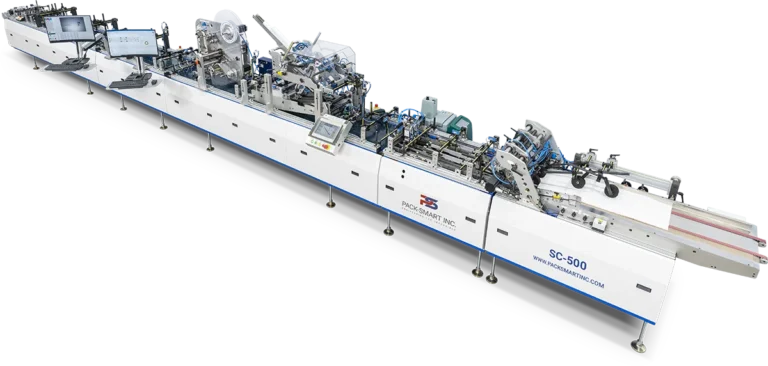
The SC-500 Secure Card Packaging System automates inline card-to-carrier affixing, booklet tipping, DOD personalization, folding, gluing, verification, and pack-out. Designed for SIM, phone, loyalty, gift, open loop, closed loop, and ID cards, it supports high-speed secure packaging with Delta-X traceability.
The CP-250 Duplex Card Personalization System automates high-speed card printing, encoding, labeling, verification, and defect diversion for open loop, closed loop, and payment cards. It supports DOD personalization, barcode inspection, Delta-X tracking, 24/7 operation, and speeds up to 30,000 PPH.
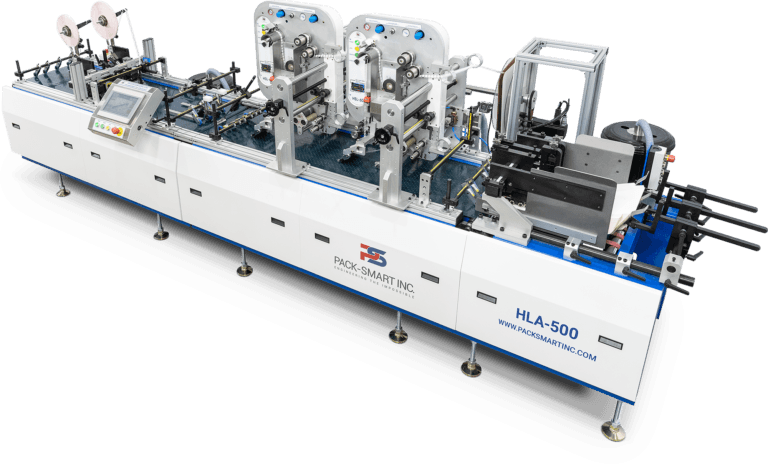
The HLA-500 High-Speed Label Application System applies pressure-sensitive labels, Velcro labels, and hi/low tack tape for high-value packaging and print finishing workflows. It supports speeds up to 15,000 PPH, ±0.5 mm affixing accuracy, quick changeovers, and modular inline integration.
Production Challenges
Label application becomes unstable when web handling, product registration, dispense timing, surface behaviour, and verification are treated as separate functions.
Spacing, skew, conveyor slip, height variation, or inconsistent leading edges can move the target area relative to label dispense.
Roll tension, liner tracking, die-cut variation, static, label stiffness, and adhesive behaviour can change peel and transfer conditions.
Curvature, texture, coatings, low-surface-energy materials, dust, moisture, or temperature can affect contact and final adhesion.
A completed dispense cycle does not prove label presence, position, readability, identity, or association with the intended product.
Application Fit
The applicator, product transport, web path, registration, and inspection strategy are selected around the label, product, placement tolerance, and downstream process.
Apply pressure-sensitive labels carrying branding, instructions, barcodes, serial data, regulatory information, or other approved content.
Apply activation, variable-data, security, promotional, or other labels within card personalization and packaging workflows.
Affix labels, tapes, closures, or label-based features to flat blanks or converted products before folding and pack-out.
Coordinate label application with product identity, variable printing, code reading, or database logic so the intended label remains associated with the correct item.
Frequently Asked Questions
These are the questions manufacturers and production teams commonly ask when evaluating this application.
Labelling can be configured for cards, cartons, sheets, rigid products, pouches, and other packages after the product surface, geometry, target area, label construction, adhesive, roll format, and line speed are evaluated.
Potentially. Integration depends on available space, product path, line controls, speed synchronization, guarding, utilities, and the upstream and downstream equipment. Pack-Smart evaluates the complete process before defining the interface.
Sensors or machine vision can be used to confirm label presence, position, orientation, printed information, code readability, or another defined acceptance criterion after application.
The response is application-specific. The control system can identify the affected product or process state and trigger a controlled reject, alternate route, alarm, hold condition, or line stop when that response is required.
Changeover requirements depend on product range and module configuration. Mechanical adjustments, recipes, guides, sensors, tooling, and control parameters can be designed around repeatable setup and clear line-clearance requirements.
Provide representative products and labels, roll and liner specifications, application location, placement tolerance, surface details, target speed, variable-data requirements, inspection criteria, reject logic, and downstream handling.
Technology Assessment
Share the product, label construction, roll format, target position, tolerance, target output, data requirements, and inspection criteria. Pack-Smart can identify the label handling, application, registration, verification, and reject approach required for the line.