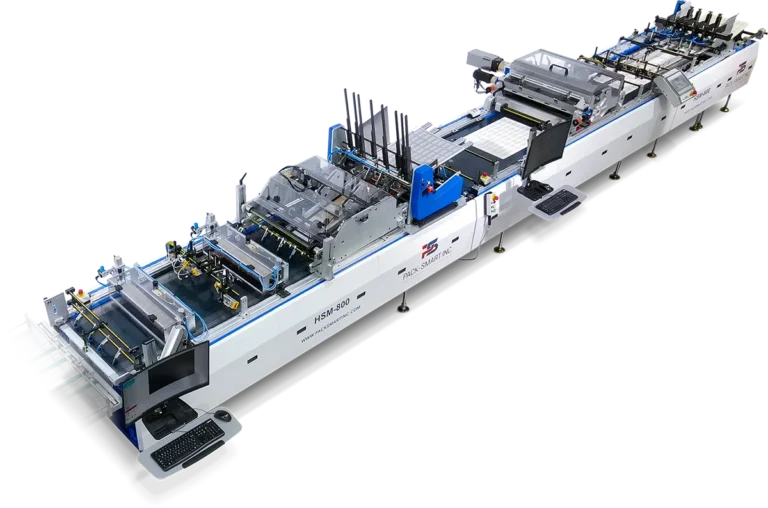
HSM-800
High-Speed Sheet Mounting System
The HLB-500 is a carton labeling and bundling system that automates feeding, pressure-sensitive top labeling, vision inspection, reject handling, counting, stacking, banding and finished-bundle delivery.
Specialty Print Finishing Application
Specialty print finishing systems combine feeding, affixing, inserting, printing, die-cutting, embossing, folding, gluing, inspection, or delivery in one coordinated production path. Pack-Smart Inc. integrates the operations around material control and production timing.
Specialty Print Finishing Applications
Specialty printed products often require precise feeding, registration, affixing, folding, gluing, personalization, and inspection before they can move to final delivery or packaging.
Pack-Smart configures modular print finishing systems around the physical product and required sequence. A line can combine sheet or piece feeding, controlled transport, registration, component handling, label or tape application, adhesive dispensing, folding, digital printing, inspection, reject handling, counting, and delivery.
The process must keep every added feature aligned with artwork, die-cut geometry, fold lines, perforations, glue areas, and downstream equipment. The system architecture is therefore based on material behaviour, placement tolerance, attachment method, inspection criteria, output requirements, and the surrounding production line.
Relevant Systems
Explore Pack-Smart systems for coordinating specialty print finishing operations across feeding, transport, placement, print, die-cutting, embossing, folding, gluing, inspection, and delivery. Final architecture depends on substrate, process sequence, registration, data requirements, verification, throughput, and finished output.
The HLB-500 is a carton labeling and bundling system that automates feeding, pressure-sensitive top labeling, vision inspection, reject handling, counting, stacking, banding and finished-bundle delivery.
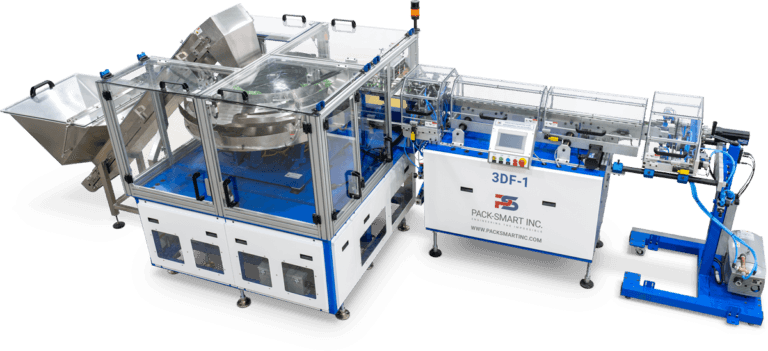
The 3D Product Feeding System automates bulk loading, sorting, orienting, buffering, and placement of loose 3D products. Designed for FMCG and pharmaceutical packaging workflows, it uses vibratory feeding, redundant buffers, lugged transport, and pick-and-place handling to deliver up to 200 products per minute.
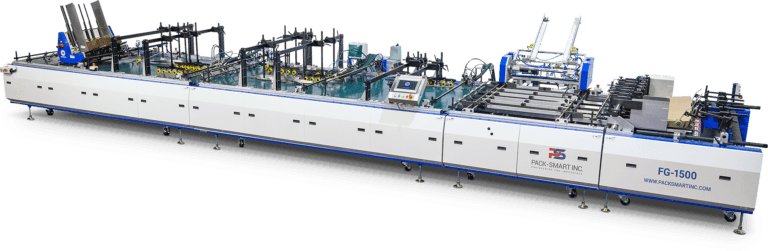
The FG-1500 Specialty Corrugated Folder Gluer produces POP displays and reinforced corrugated packaging with integrated folding, gluing, affixing, and finishing. It processes E, B, C flute and double-wall corrugated board with up to 60-inch blank width, 2,500 PPH speeds, and ±0.5 mm affixing accuracy.
Production Challenges
Finishing defects often begin when substrate variation, component presentation, registration, and attachment are treated as separate operations instead of one coordinated process.
Coated, embossed, foil-stamped, laminated, textured, or static-prone materials can respond differently to feeding, transport, adhesive, printing, and inspection.
Labels, tapes, samples, cards, inserts, closures, and rigid elements may require different feeding, orientation, and placement methods within the same product family.
A component placed across a fold, cut, perforation, glue area, or functional feature can prevent the printed product from converting or operating correctly.
Frequent changes in artwork, dimensions, components, adhesives, and finishing recipes can introduce setup error unless guides, tooling, controls, and inspection are coordinated.
Application Fit
The final configuration is selected around the printed carrier, finishing component, required operation, placement tolerance, and downstream process.
Add cards, coupons, labels, samples, inserts, or response elements to registered printed carriers before folding or delivery.
Coordinate decorative and functional additions on high-value printed products where appearance, alignment, and surface protection are critical.
Apply pressure-sensitive labels, tapes, hook-and-loop components, or other functional elements within a defined placement area.
Assemble printed carriers with secondary pieces, rigid components, informational materials, or identification elements in a controlled sequence.
Frequently Asked Questions
These are the questions manufacturers and production teams commonly ask when evaluating this application.
A configured line can combine feeding, registration, component placement, label or tape application, adhesive dispensing, folding, gluing, digital printing, inspection, rejection, counting, and delivery. The exact sequence depends on the product.
Potential materials include paper, paperboard, laminated pieces, specialty stocks, envelopes, mailers, labels, and other converted print products. Representative samples are required to confirm feeding, transport, and surface response.
The method is selected around component geometry and behaviour. Friction or magazine feeding, vibratory feeding, pick-and-place handling, vacuum transport, guides, sensors, and registration devices can be combined as needed.
Sensors or machine vision can verify defined criteria such as component presence, identity, orientation, position, adhesive pattern, print content, and product completeness before release.
Yes. Recipe-driven controls, adjustable guides, modular tooling, stored inspection settings, and clear setup procedures can reduce changeover effort. Actual changeover requirements depend on the range of formats and components.
Provide representative products and components, artwork or drawings, material specifications, acceptable variation, placement tolerances, attachment requirements, target output, inspection criteria, and details of upstream and downstream equipment.
Application Assessment
Share the printed product, secondary components, required sequence, placement tolerances, attachment method, target output, and inspection criteria. Pack-Smart can identify the feeding, finishing, verification, and delivery modules required for the application.