IS-1500
High-Speed Inlet Spotter for Reinforced Packaging
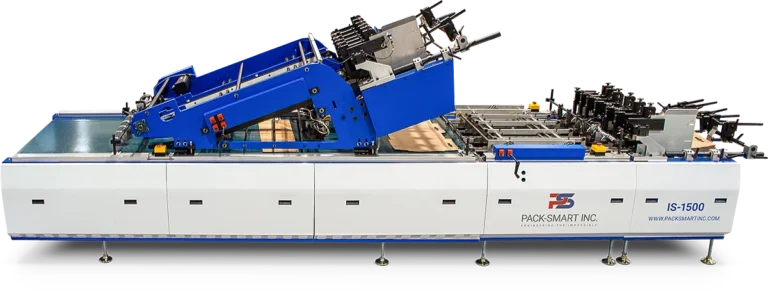
The IS-1500 High-Speed Inlet Spotter places stiffeners, windows, and secondary materials onto carriers for reinforced corrugated and display packaging.
Corrugated Application
Corrugated folding and gluing systems coordinate blank transport, fold sequence, adhesive application, compression, and inspection. Pack-Smart Inc. integrates these control points so package geometry and bond formation remain stable through finishing.
Corrugated Applications
A correctly printed and die-cut corrugated blank can still fail if the fold sequence, adhesive pattern, compression, or final geometry is not controlled through conversion.
Pack-Smart configures modular corrugated folding and gluing systems that can combine blank feeding, registration, pre-folding, component affixing, cold-glue or hot-melt application, straight-line and multi-directional folding, compression, inspection, and delivery. The final architecture depends on the board construction, blank geometry, score pattern, adhesive, finished format, and required output.
Corrugated board resists folding differently according to flute, thickness, score quality, coating, and environmental condition. The system must control the blank throughout the fold sequence while maintaining adhesive placement, panel alignment, compression, and finished-package dimensions.
Relevant Systems
Explore Pack-Smart systems for folding, gluing, compression, and controlled finishing of corrugated blanks. Final configuration depends on blank geometry, board behavior, fold sequence, adhesive pattern, compression requirements, inspection logic, throughput, and finished package delivery.
The IS-1500 High-Speed Inlet Spotter places stiffeners, windows, and secondary materials onto carriers for reinforced corrugated and display packaging.
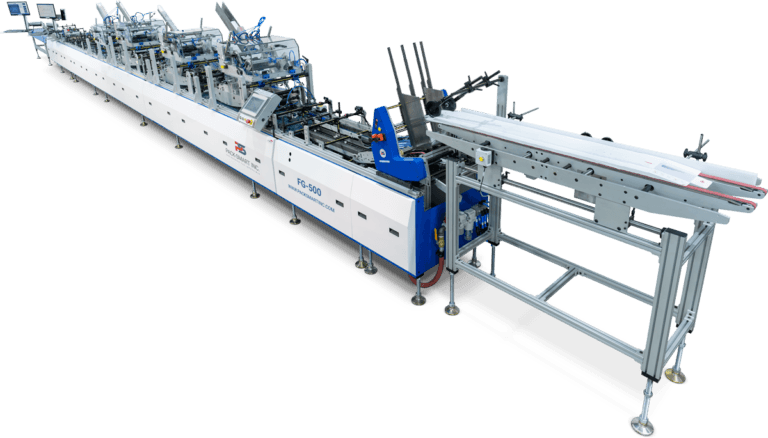
The FG-500 Specialty Carton Folding and Finishing System automates carton kitting, affixing, folding, gluing, DOD personalization, inspection, and reject handling. It supports ±0.4 mm affixing accuracy, 600 DPI printing, and Delta-X quality control for secure, conforming finished packages.
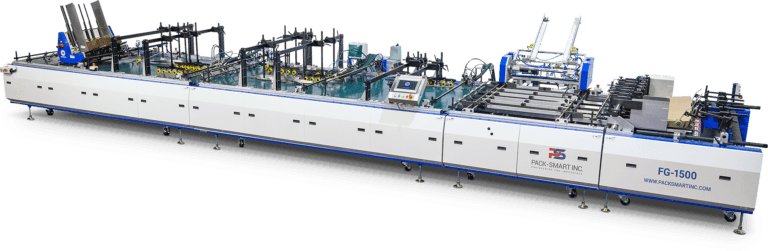
The FG-1500 Specialty Corrugated Folder Gluer produces POP displays and reinforced corrugated packaging with integrated folding, gluing, affixing, and finishing. It processes E, B, C flute and double-wall corrugated board with up to 60-inch blank width, 2,500 PPH speeds, and ±0.5 mm affixing accuracy.
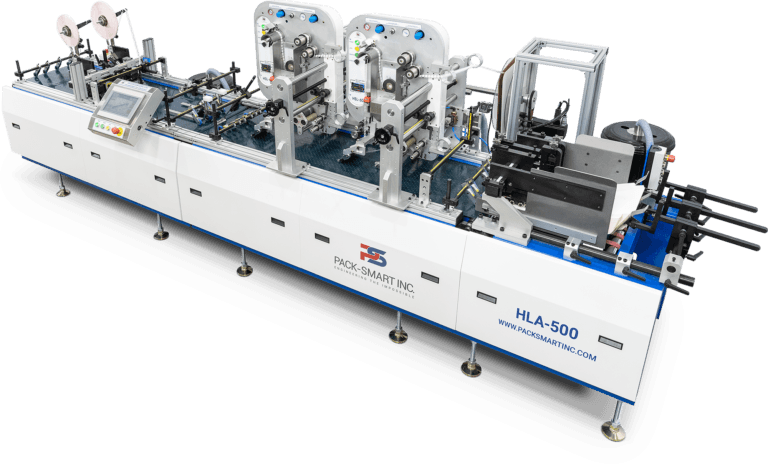
The HLA-500 High-Speed Label Application System applies pressure-sensitive labels, Velcro labels, and hi/low tack tape for high-value packaging and print finishing workflows. It supports speeds up to 15,000 PPH, ±0.5 mm affixing accuracy, quick changeovers, and modular inline integration.
Production Challenges
Reliable conversion depends on coordinating board behaviour, fold geometry, adhesive application, compression, and changeover requirements.
Corrugated panels can resist folding or reopen after the fold point, affecting alignment, compression, and finished-package geometry.
Changes in score depth, die-cut position, flute, thickness, or blank dimensions can shift the fold and glue relationship.
Incorrect glue position, quantity, temperature, timing, or compression can produce weak, contaminated, or partially bonded packages.
Multi-panel, right-angle, auto-bottom, and reinforced structures require coordinated folds that do not interfere with components or previous adhesive operations.
Application Fit
The system configuration is selected around the corrugated structure, fold sequence, adhesive requirements, reinforcement features, and required finished output.
Register, glue, fold, compress, and deliver corrugated cases or cartons with controlled panel alignment and closure geometry.
Produce folded tray, sleeve, mailer, and presentation structures with defined corners, panels, locks, and adhesive areas.
Coordinate complex folds, large panels, reinforced areas, clips, inserts, windows, or other functional components for display-ready output.
Add and secure secondary materials before completing the fold and glue sequence for high-value or structurally demanding packages.
Frequently Asked Questions
These are the questions manufacturers and production teams commonly ask when evaluating this application.
The practical material range depends on flute, thickness, stiffness, coating, blank size, score design, and finished geometry. Representative blanks must be tested before the handling method is confirmed.
Potentially. Straight-line, pre-fold, right-angle, auto-bottom, multi-panel, and other engineered sequences can be evaluated against the blank geometry, available line length, and required process order.
Yes, when appropriate for the board, package design, production environment, bond requirement, and downstream process. One or both adhesive methods may be incorporated into the system.
Yes. Reinforcement inserts, clips, windows, labels, and other components can be fed and affixed before the required folding and gluing operations when the sequence is properly engineered.
Sensors or machine vision can be configured to inspect blank position, adhesive presence, component placement, panel alignment, closure, and other defined acceptance criteria before delivery.
Provide representative blanks, structural drawings, board specifications, fold sequence, adhesive requirements, component details, acceptable tolerances, target throughput, inspection criteria, and details about the surrounding line.
Application Assessment
Share the corrugated blank, structural drawing, board specification, fold sequence, adhesive requirements, and target output. Pack-Smart can identify the feeding, folding, gluing, inspection, and delivery modules required for the application.