CE-250
Carton Erecting Station
This system is ideal for applications requiring high precision and fast, recipe-driven changeovers, making it a versatile addition to any production line.
Technology Category
Carton erecting technologies convert flat blanks into stable, correctly oriented structures for downstream loading, closing, inspection, or finishing. Pack-Smart Inc. coordinates blank feeding, opening, forming, registration, and handoff around the required carton geometry.
Carton Erecting Technologies
Carton erection has to turn a flat blank into a stable, correctly oriented structure that can enter the next packaging operation without losing geometry, registration, or production flow.
Pack-Smart integrates carton erecting into modular packaging lines that can include blank feeding, opening, forming, folding, locking or gluing, product loading, inspection, and downstream delivery. The forming sequence is engineered around the carton design rather than treated as an isolated mechanical step.
The required architecture depends on blank dimensions, board grade, score pattern, closure design, pre-break condition, carton geometry, target output, and what happens immediately after erection. Controlled feeding and positive carton handling are important because dimensional variation introduced during forming can affect loading, closing, labelling, and pack-out.
Technology Category
Explore the Pack-Smart technologies assigned to this category. A category can include multiple technologies with different functions, configurations, and application requirements.
This system is ideal for applications requiring high precision and fast, recipe-driven changeovers, making it a versatile addition to any production line.
Relevant Systems
The technologies in this category are used in the following Pack-Smart automated systems.
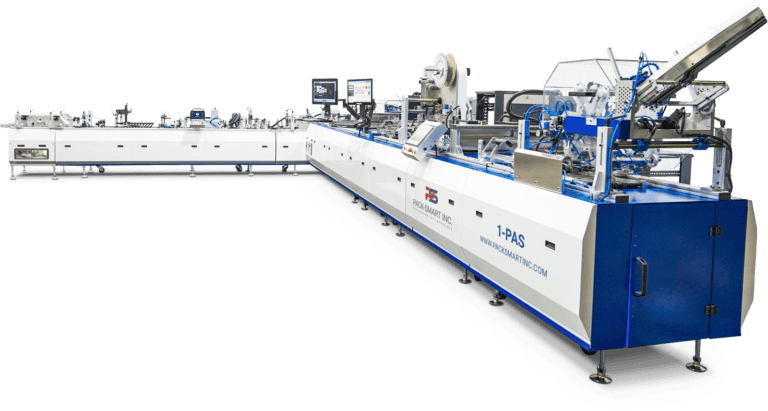
The 1-PAS Inline Secure Card Packaging System personalizes, affixes, seals, batches, bundles, and packs out secure open and closed loop cards in one workflow. It supports 20,000 PPH, duplex personalization, 600 DPI UV DOD printing, ±0.5 mm affixing accuracy, and Delta-X reporting.
The CP-250 Duplex Card Personalization System automates high-speed card printing, encoding, labeling, verification, and defect diversion for open loop, closed loop, and payment cards. It supports DOD personalization, barcode inspection, Delta-X tracking, 24/7 operation, and speeds up to 30,000 PPH.
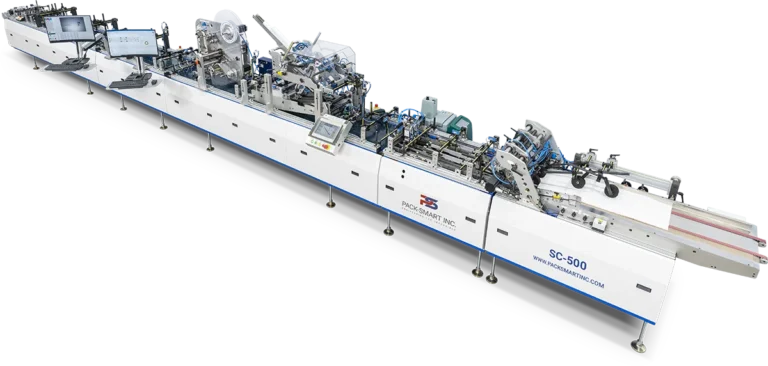
The SC-500 Secure Card Packaging System automates inline card-to-carrier affixing, booklet tipping, DOD personalization, folding, gluing, verification, and pack-out. Designed for SIM, phone, loyalty, gift, open loop, closed loop, and ID cards, it supports high-speed secure packaging with Delta-X traceability.
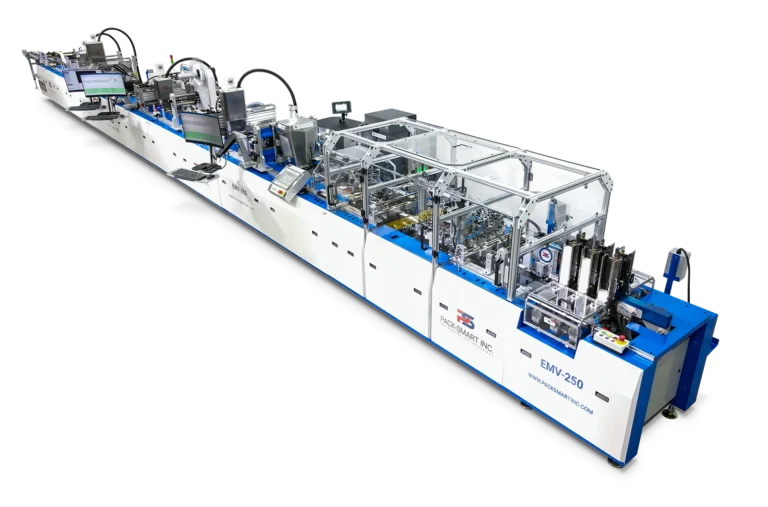
The EMV-250 Smart Card Issuance System automates contact and contactless encoding, DOD personalization, verification, and production tracking for dual interface chip cards. It supports payment cards, SIM cards, and open loop cards at speeds up to 10,000 cards per hour.
Production Challenges
Reliable erection depends on blank quality, score behaviour, forming sequence, tooling, and how the formed carton is supported before the next operation.
Moisture, coating, caliper, warp, and score variation can change how a blank separates, opens, and folds.
A carton can enter the forming sequence partially opened, misregistered, or with a panel outside the intended tooling path.
Poor squareness, panel spring-back, weak locks, or inconsistent adhesive can make the erected carton difficult to load or close downstream.
If the forming station is not synchronized with loading and accumulation, erected cartons can queue, collide, deform, or starve the next process.
Application Fit
The forming method is selected around the blank design, board behaviour, closure style, production sequence, and required presentation to downstream equipment.
Open and square pre-glued cartons for product loading, insertion, closing, and final pack-out.
Form carton designs that rely on mechanical tabs, locks, or interlocking panels rather than a simple pre-glued seam.
Present erected cartons at a controlled pitch and orientation to robotic, pick-and-place, or insertion processes.
Coordinate carton formation with product loading, component insertion, inspection, folding, gluing, labelling, and delivery.
Frequently Asked Questions
These are the questions manufacturers and production teams commonly ask when evaluating this application.
Carton erecting is application-specific. The blank design, board grade, caliper, score pattern, closure style, coatings, dimensions, and downstream handling requirements must be reviewed with representative samples.
Potentially. Integration depends on available space, product path, line controls, speed synchronization, guarding, utilities, and the upstream and downstream equipment. Pack-Smart evaluates the complete process before defining the interface.
Sensors or machine vision can be configured to confirm blank presence, carton opening, orientation, formed geometry, panel position, or another measurable acceptance criterion before loading or delivery.
The response is application-specific. The control system can identify the affected product or process state and trigger a controlled reject, alternate route, alarm, hold condition, or line stop when that response is required.
Changeover requirements depend on product range and module configuration. Mechanical adjustments, recipes, guides, sensors, tooling, and control parameters can be designed around repeatable setup and clear line-clearance requirements.
Provide representative carton blanks, structural drawings, board specifications, score and glue information, closure design, target output, downstream loading method, inspection criteria, and required changeover range.
Technology Assessment
Share the carton blank, structural drawing, board specification, closure method, target output, and next production step. Pack-Smart can identify the feeding, erecting, forming, inspection, and transfer controls required for the application.