

Blog
She Trusts Me… She Trusts Me Not. Counterfeiting Doubles Its Market Share
In 2021, 2.3% of global trade was counterfeit. By 2030, 5% of all global goods sold will be fake. That’s $2.8 trillion lost… or the total GDP of Brazil.
Rising criminal sophistication, particularly “superfakes” and 3D printing, untraceable crypto payments and global trade instability whipped up the perfect storm for counterfeit growth.
Clothing and fashion brands remain well-known categories where fakes thrive; however, everything from spare parts, dyes, pigments, gift cards, and packaging are compromised. According to Mapping Global Trade in Fakes, 50 of 96 identified product categories now report counterfeit shadow markets.
Fakes easily blend into markets because systems don’t request automated proof or authenticity through the supply chain to point-of-sale. There are simply too many blind spots where visibility and overwatch vanish; this is how fakes stealthily arrive on shelves and in customer hands.
Leading brands use Delta-X Trust to protect against counterfeiting from production to post-purchase. It’s an easy decision for them: customer trust is hard to earn, easy to lose, and counterfeiting puts reputation, brand equity, and revenue directly at risk.
Psychological Trick or Truth
Consumers don’t reason their way to purchase, frequently falling prey to criminals while shopping. Most people accept what’s presented as authentic in trusted environments. They trust the familiar, rarely peering past the smoke and mirrors at POS. This means a counterfeiter only needs to appear legitimate in a neutral setting to win. Criminals simply arrange conditions to guide the consumer into naturally concluding their purchase is authentic… when it’s not.
How? A convincing label. A scannable code. A URL linking to a fake product page. Every false signal indicates authenticity, yet none prove it. The consumer, presented with recognizable cues, does what comes naturally: they complete the picture themselves and label the product as ‘real’ and buy it.
The supply chain, for all its sophistication, has been complicit in this. It employs systems to track movement but can’t verify product identity. The chain knows where a product has travelled, but not if the actual product in front of them is the same one tracked earlier during production.
To mitigate, the packaging industry delivered the appearance of legitimacy to circumvent fakes with barcodes, serial numbers, QR codes or NFC and called it security; however, it is not security. It is theater. Credible theater. But theater, nonetheless.
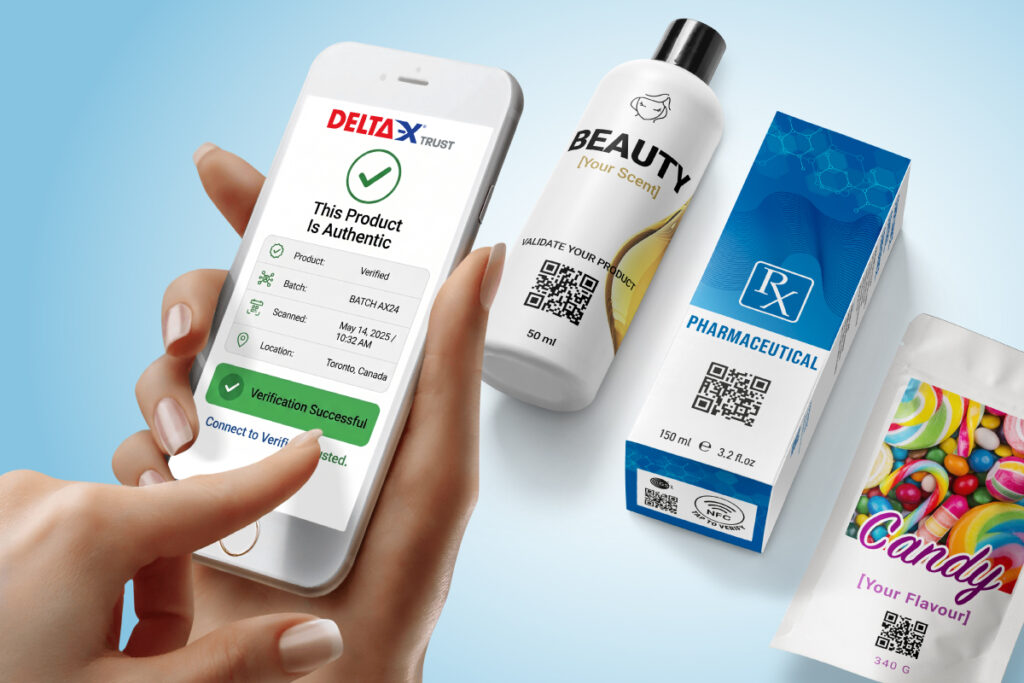
The Antidote: Delta-X Trust and Connected Packaging:
To combat fakes, the anti-counterfeit packaging category will reach USD $368 billion by 2030, growing at a CAGR of 12.77% (2025–2030). But will it be enough to be effective? And what’s the big idea to stop counterfeiting at scale? The Answer: Connected Packaging
Connected Packaging and Delta-X Trust end the counterfeit act by replacing theatre with reality and proof. Delta-X Trust delivers integrated track and trace technology that always demands proof of authenticity and won’t accept anything less. The brand, supply chain and the customer are protected.
Delta-X Trust: How Connected Packaging Works
Most brands attach data to their products. Delta-X Trust embeds validation within the product/packaging itself. The difference is now structural instead of technical.
Out technology enables each unit to declare authenticity. Not claim. Not suggest. Not reference a record that says so. But prove — cryptographically, mathematically, irrefutably — it was issued by the brand whose name it carries.
This is the shift from identification to verification. From data to proof. From the appearance of security to its substance. The counterfeiter manufactures consent through careful arrangement of symbols. Delta-X Trust manufactures certainty using mathematics, and mathematics cannot yield to imitation. The supply chain and the end customer are protected.
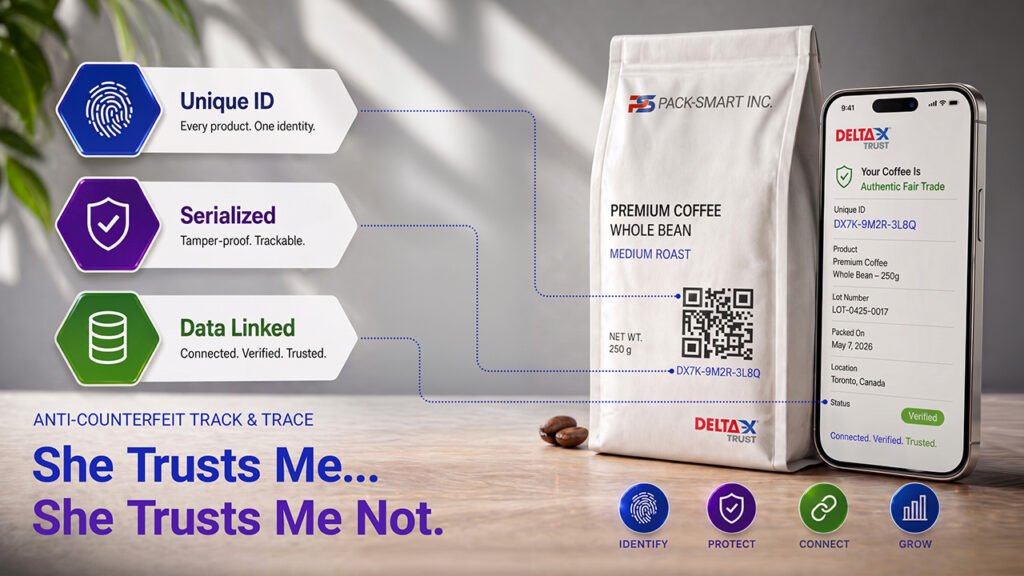
Built In Proof
Delta-X Trust is not a feature appended to existing packaging workflows. It is the architecture beneath them — an Elliptic Curve Cryptography platform engineered to operate at industrial scale, from the moment of identity issuance to the moment of market authentication.
Every unit receives a digital fingerprint during production. Not a number. Not a serial. A cryptographic signature — computed from a private key that never leaves the Delta-X Trust system. It is bound to the unit’s identity and production metadata, and verifiable by anyone who holds the corresponding public key. It cannot be guessed, copied, or transferred to a unit that was not issued by the brand.
Issuing Identity
A unique identifier and ECC key pair are generated for each unit. The private key is protected under brand authority, never exposed. The digital signature binds the unit’s identity to its production reality.
GS1 Digital Link Encoding
The signature is carried within the GS1 Digital Link structure. It is either embedded directly in the printed code for field verification without connectivity or held server side with the code as a cryptographic pointer. The standard provides the address. Delta-X Trust provides the credential.
Inline Execution at Scale
At 30,000 units per hour, Delta-X Trust synchronizes identity generation with the print engine in real time. Each code printed is unique, cryptographically distinct, and bound to exactly one unit in the serialization record. There are no duplicates. There are no approximations.
Verification Before Shipping
Every unit is inspected before it enters the supply chain — code readability, data integrity, and identity matching. A broken identity is rejected at the line. It does not propagate. It does not reach a consumer. The system does not permit it.
Truth Be Told
At any scan point — warehouse, border, retail floor, or in a consumer’s hand — the Delta-X Trust response layer validates the ECC signature and returns a verdict. Logged, timestamped, and actionable.
The public needs a clear conclusion, not a set of considerations to weigh. Delta-X Trust operates on the same principle. Every scan produces one of four outcomes. Each is precise.
Authentic: Signature valid. Identity confirmed. The unit is what it claims to be. Cleared.
Duplicate: This code has been seen before, elsewhere. A clone has been introduced into the chain. Flagged.
Tampered: The signature does not match the payload. Something has been altered. Investigated.
Unknown: No record of issuance exists. Delta-X Trust never issued this unit. Rejected.
There is no middle outcome. There is no “probably authentic.” The mathematics does not hedge. The system does not equivocate. Either the proof holds, or it does not.
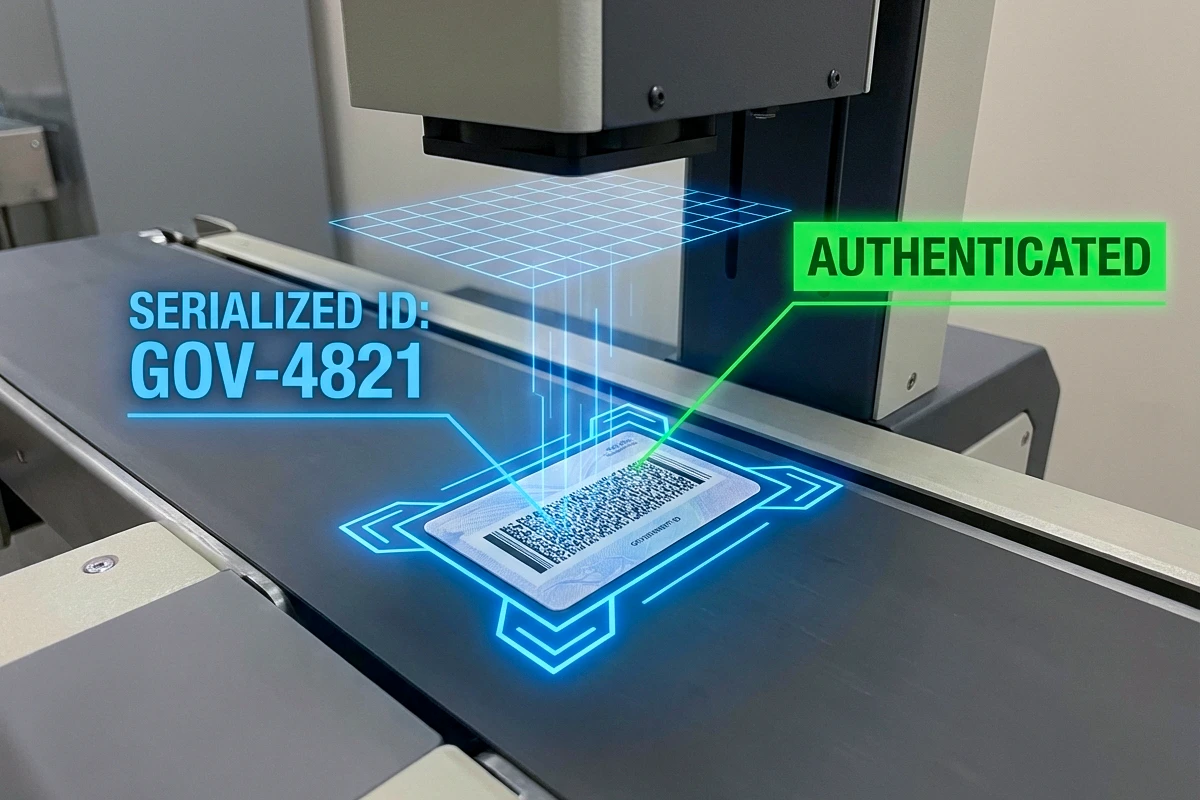
Reducing Counterfeiting
Lasting influence does not come from persuasion alone — it comes from altering the conditions under which decisions are made. Delta-X Trust does not persuade counterfeiters to stop. It removes the conditions that allow them to succeed.
When every unit carries a cryptographic credential that cannot be replicated, the economics of counterfeiting collapse. A copy that fails authentication on first scan is not a product — it is evidence. The market that accepted imitation because it could not distinguish it from the genuine article now has a mechanism that can. And that mechanism operates invisibly, automatically, at every point of contact in the chain.
For brands, this means regained control — not of the narrative, but of the reality beneath it. For regulators, it means verifiable compliance that does not depend on the word of the regulated. For consumers, it means the trust they extend without thinking has, for the first time, been earned.
Delta-X Trust: Final Position
The invisible architecture of trust has always existed. Now it can be verified.
The counterfeiter did not invent trust. They exploited its absence of proof. Every fake that reached a consumer did so because the system offered signals without substance — identity without verification, data without proof. Delta-X Trust does not argue against them. It simply makes proof a requirement.
And in a system where proof is required, the counterfeit cannot survive its first encounter with the market.
Not as a feature. Not as an improvement. As infrastructure.
The kind that operates beneath the surface, unnoticed until the moment it is needed, and then utterly decisive.
What would it mean for your brand if every unit could prove itself?
The conversation is worth having.
Questions?
Want to learn more? Get in touch with us here!